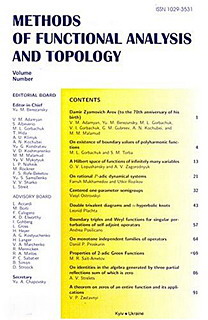
Methods of Functional Analysis
and Topology
Editors-in-Chief: A. N. Kochubei,
G. M. Torbin
ISSN: 1029-3531 (Print), 2415-7503 (Online)
Founded by Yu. M. Berezansky in 1995.
Methods of Functional Analysis and Topology (MFAT), founded in 1995, is a peer-reviewed journal publishing original articles and surveys on general methods and techniques of functional analysis and topology with a special emphasis on applications to modern mathematical physics.
MFAT is an open access journal, free for authors and free for readers.
Indexed in: MathSciNet, zbMATH, Scopus, Web of Science, DOAJ, Google Scholar
Latest Articles (June, 2026)
On the Range of a Generalized Derivation
Hamza El Mouadine, Abdelkhalek Faouzi, Youssef Bouhafsi
MFAT 32 (2026), no. 2, 129-138
129-138
Let $\mathcal{L}(H)$ denote the algebra of all bounded linear operators on a complex infinite dimensional Hilbert space $H$ into itself. Given $A,B\in \mathcal{L}(H)$, the generalized derivation $\delta_{A,B}\in \mathcal{L}(\mathcal{L}(H))$ is defined by $\delta_{A,B}(X)=AX-XB$. For hyponormal operators $A$ and $B$, L.A. Fialkow gave necessary conditions for which the range of $\delta_{A,B}$ is norm closed in $\mathcal{L}(H)$ [13]. In this paper, we present necessary or sufficient conditions under which the generalized derivation $\delta_{A,B}$ has closed range, where $A$ and $B$ are $p$-hyponormal operators. We give a characterization for the range of $\delta_{A,B}$ to have closed range in the case when $A$ and $B$ are cyclic subnormal operators.
The dual of $ (p,\sigma)$-weakly summable sequences space and its application
MFAT 32 (2026), no. 2, 139-151
139-151
In this paper, we prove that the space of strongly \((r, p, \sigma)\)-summable sequences is the topological dual of the space of \((p, \sigma)\)-weakly summable sequences. As an application, we provide a new proof that an operator \( T: E \to F \) is \((p, \sigma)\)-absolutely continuous if and only if its adjoint \( T^*: F^* \to E^* \) is strongly \((p^*, \sigma)\)-continuous.
Reconstruction of Piecewise Constant Potential with Phaseless Reflection Coefficient
MFAT 32 (2026), no. 2, 116-128
116-128
Let us consider the scattering theory of one-dimensional Schrödinger equation defined by piecewise constant potentials with compact support. We construct the asymptotics of reflection coefficient by iterating the transition matrices. The jump points of the step potential appear in the asymptotics of reflection coefficient. Accordingly, we investigate the modulus of reflection coefficient. The modulus is connected to the zero set of reflection coefficient via Nevanlinna-Levin type of representation theorem. The growth theory of zero set of the reflection coefficient plays a role.
Fixed point results of a generalized modified $F-$contraction via rectangular $G-\alpha$-admissible mapping with application
MFAT 32 (2026), no. 2, 97-115
97-115
In this paper, we introduce the notion of a generalized modified $F-$contraction via rectangular $G-\alpha-$admissible mapping and establish some new fixed point results under Wardowski's $F-$contractive condition $(F1)$ together with an auxiliary function $\phi$ in the setting of $G-$metric spaces. Our new fixed point results improve, generalize and unify several related result in the existing literature. Moreover, we give some non-trivial examples to verify our results. Finally, we derive the existence of a solution to an integral equation to support our main findings.