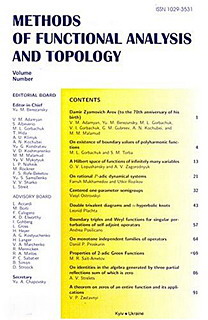
Vol. 31 (2025), no. 3

Bisingular Integral with Summable Density
↓ Abstract
MFAT 31 (2025), no. 3, 153-160
153-160
In this paper, we introduce new metric characteristics in the space of summable functions. Using these metric characteristics it is obtained Zigmund-type inequalities for the bisingular integral. It is constructed an invariant $T_p$ space for bisingular integral operator according to the inequality. Furthermore, the existence and uniqueness of the solution to the nonlinear bisingular integral equation within the invariant space $T_p$ are proven using the method of successive approximations.
Inequality of Riemann-Stieltjes-$ \Delta $-Integral for Hilbert Spaces on Time Scales
Bosede Alfred O., Afariogun David A., Ayeni Elizebeth O.
MFAT 31 (2025), no. 3, 161-171
161-171
In this paper, the inequality of Riemann-Stieltjes integral is defined for functions of Hilbert space. The concept of time scales is introduced to unify both discrete and continuous problems. Also, the definition and properties of Riemann-Stieltjes integral are used in the application of self-adjoint and unitary operators in Hilbert spaces. Thees results are obtained on time scales.
Existence result for some coupled nonlinear parabolic systems in Orlicz-Sobolev spaces
Jabir Ouazzani Chahdi, Mohamed Bourahma, Hassane Hjiaj, Khalid Kaiba
MFAT 31 (2025), no. 3, 172-194
172-194
Consider the nonlinear parabolic system $$\left\{\begin{array}{lll} \frac{\partial b_i(x,u_i)}{\partial t}-\mathop{\rm div}\Big(\mathcal{A}(x,t,u_i,\nabla u_i)+\Phi_i(x,t,u_i)\Big)+f_i(x,u_1,u_2)= 0 &\mbox{ in } Q_T \\ u_i=0 &\mbox{ on } \Gamma \\ b_i(x,u_i)(t=0)=b_i(x,u_{i,0})&\mbox{ in } \Omega,\end{array}\right.$$ where $ i=1,2$. In this paper we deal with the renormalized solution for the above system in Orlicz-Sobolev spaces where $f_i$ is a Carath\'{e}odory function satisfying some growth assumptions. The main term which contains the space derivatives and a non-coercive lower order term are considered in divergence form satisfying only the original Orlicz growths.
On the classes of Null almost L-weakly compact and Null almost M-weakly compact operators
Safae El Filali, Khalid Bouras
MFAT 31 (2025), no. 3, 195-203
195-203
In this paper, we establish conditions under which each positive Null almost L-weakly compact operator is Null almost M-weakly compact and conversely. Moreover, we provide the necessary and sufficient conditions under which any positive Null almost L-weakly compact operator $T: E\rightarrow F$ admits a Null almost M-weakly compact adjoint $T': F'\rightarrow E'$. Finally, we give some connections between the class of Null almost L-weakly compact (resp. Null almost M-weakly compact) operators and the class of L-weakly compact (resp. M-weakly compact).
Spectral Properties of Essential Pseudospectra under Polynomially Non-Strict Singular Perturbations
MFAT 31 (2025), no. 3, 204-221
204-221
This paper investigates the essential pseudospectra of closed linear operators in Banach spaces, focusing on perturbations induced by polynomially non-strictly singular operators, a class that extends the concept of polynomially strictly singular operators. New results are presented regarding the behavior of the essential pseudospectra under these perturbations. In particular, we explore the impact on the left (resp. right) Weyl and Fredholm essential pseudospectra. Additionally, we examine the essential pseudospectra of the sum of two bounded linear operators and apply the results to characterize the pseudo-Fredholm spectra of \( 2 \times 2 \) block operator matrices.
Inertial KM-type algorithm for solving split monotone variational inclusion problem and hierarchical fixed point problem
Mubashshir U. Khairoowala, Shamshad Husain, Mohd Furkan
MFAT 31 (2025), no. 3, 222-237
222-237
The primary objective of this paper is to present and investigate an inertial Krasnoselski-Mann (KM) type iterative method for approximating a common solution to a split monotone variational inclusion problem and a hierarchical fixed point problem for a finite family of $l$-strictly pseudocontractive non-self mappings. Additionally, we demonstrate that the iterative sequences provided by the proposed method converge weakly to a common solution to these problems. The methodology and conclusions described in this work extend and unify previously published findings in this domain. Finally, a numerical example is presented to demonstrate the suggested iterative method's convergence analysis of the sequences obtained. We also carried out a justification how the inertial term is useful.
Fixed Point Theorem for $\psi$-Geraghty Contraction Type Mappings in b-Metric Spaces with Application
Sabita Kumari, Sandip Shrivastava, Shraddha Rajput
MFAT 31 (2025), no. 3, 238-246
238-246
In this paper, we introduce a new class of contractive mappings, called generalized $\psi$-Geraghty contractions, in the framework of b-complete metric spaces. We establish a unique fixed-point theorem that extends existing results in fixed-point theory. An illustrative example with a graphical representation demonstrates the validity of our findings. Furthermore, we apply the main result to an integral equation, highlighting its effectiveness in ensuring the existence and uniqueness of solutions. This work underscores the theoretical significance and practical applicability of generalized $\psi$-Geraghty contractions in mathematics, physics, and engineering.
On $m$-quasi-$n$-power-totally-$(\alpha,\beta)$-normal operators
Pradeep Radhakrishnan, Sid Ahmed Ould Ahmed Mahmoud, P. Maheswari Naik
MFAT 31 (2025), no. 3, 247-260
247-260
In this paper, we introduce the notion of $m$-quasi-$n$-power-totally-$(\alpha,\beta)$-normal operators on a Hilbert space $\mathscr{H}$ as : An operator $\mathcal{L}$ is called $m$-quasi-$n$-power-totally-$(\alpha,\beta)$-normal $(0\leq \alpha \leq 1 \leq \beta)$ if \begin{align*} \alpha^{2}\mathcal{L}^{m*}(\mathcal{L}-\lambda)^{*}(\mathcal{L}-\lambda )^{n}\mathcal{L}^{m}& \leq \mathcal{L}^{m*}(\mathcal{L}-\lambda)^{n}(\mathcal{L}-\lambda)^{*}\mathcal{L}^{m}\\ &\leq \beta^{2} \mathcal{L}^{m*}(\mathcal{L}-\lambda)^{*}(\mathcal{L}-\lambda )^{n}\mathcal{L}^{m} \end{align*} for natural numbers $m$ and $n$ and for all $\lambda \in \mathbb{C}$. This paper aims to study several properties of $m$-quasi-$n$-power-totally-$(\alpha,\beta)$-normal operators.